

Evaluating Post-War Development Outcomes in Liberia: A County-Level Analysis Using Community Well-Being and Human Development Indexes (2008-2023)
Haven Yarl
Background
Liberia’s development trajectory was profoundly shaped by its 14-year civil conflict (1989–2003), which devastated the nation’s economy, infrastructure, and human capital. Before the war, Liberia had made modest progress in sectors such as agriculture, mining, and education; however, by the end of the conflict, the country’s socioeconomic foundations had almost entirely collapsed. The long civil conflict resulted in the deaths of an estimated 150,000 to 250,000 people and displaced over half of the population, both internally and across borders (Center for Justice and Accountability). The nation’s economy experienced a near-total collapse during the civil conflict, with GDP per capita declining by more than 80 percent between 1980 and the early 2000s, making Liberia one of the world’s poorest countries (World Bank, 2023).
The conflict’s impact on infrastructure and public services was equally catastrophic. The World Bank reported that Liberia’s national power grid and water systems were completely destroyed during the war years, leaving most communities without electricity, clean water, or sanitation (World Bank, 2004). Basic social services nearly vanished, and the health system disintegrated, with hospitals and clinics looted or burned. The education system suffered similar setbacks: thousands of schools were destroyed or abandoned, teachers fled the country, and an entire generation of children lost access to formal education (UNDP, 2006).
Liberia’s labour market was severely weakened during and after the civil conflict, leaving much of the population dependent on precarious and low-productivity work. Even prior to the Ebola crisis, formal employment opportunities were extremely limited, and the overwhelming majority of workers relied on informal activities marked by low wages, unstable income, and high vulnerability (Flomo et al., 2023). Moreover, high rates of illiteracy, poverty, and poor health outcomes severely limiting citizens’ ability to rebuild their lives. Rebuilding infrastructure, restoring basic services, and re-establishing social stability became national imperatives. These conditions underscored the urgency for post-conflict development interventions (UNDP, 2006). Furthermore, persistent inequalities between urban and rural counties, as well as between coastal and hinterland regions, made spatially targeted development strategies essential.
Post-War Development Plans
In response to these challenges, post-war governments launched a series of national development plans aimed at rebuilding the economy and improving the well-being of its people. Each of these plans was supported by substantial inflows of development assistance from multilateral and bilateral partners.
The first major national response to this challenge was the Poverty Reduction Strategy (PRS, 2008-2011), which sought to transition Liberia from emergency recovery to sustainable development. The PRS articulated a vision of “rapid, inclusive, and sustainable growth” structured around four key pillars: peace and security, economic revitalization, governance and rule of law, and infrastructure and basic services (International Monetary Fund (IMF), 2008). The plan’s overarching goal was to reduce poverty through the reconstruction of critical infrastructure, including roads, electricity, and water systems, while simultaneously restoring health and education services. The PRS also aimed to re-establish government credibility and strengthen public financial management after years of institutional breakdown. By the end of its implementation period, Liberia had recorded modest economic growth and some improvements in service delivery, although challenges remained in employment creation and equitable service distribution (IMF, 2012).
Building on the progress achieved under the PRS, the government launched the Agenda for Transformation (AfT, 2012-2017) as the second medium-term development framework. The AfT represented a deliberate shift from post-conflict recovery toward structural transformation and inclusive growth. Anchored in the long-term vision of Liberia Rising 2030, the AfT emphasized human capital development, private sector expansion, youth employment, and regional equity (Republic of Liberia, 2013; UNDP, 2013). It focused heavily on infrastructure, particularly roads, energy, and information and communications technology, as drivers of competitiveness and decentralization. The plan also prioritized institutional reforms aimed at strengthening transparency, governance, and the business environment. Expected outcomes included improved economic diversification, reduced regional disparities, and stronger human development indicators. Although implementation of the Agenda for Transformation (AfT) was disrupted by the 2014–2016 Ebola epidemic, the plan nonetheless consolidated many of the recovery gains achieved during the post-conflict period and continued to guide reform efforts in subsequent years (World Bank, 2017).
The Pro-Poor Agenda for Prosperity and Development (PAPD, 2018-2023), which succeeded the AfT, was designed to address persistent inequality and to ensure that economic growth translated into improved living conditions for all Liberians. The PAPD adopted a rights-based, equity-driven approach with four interlinked pillars: Power to the People (human development and empowerment), Economy and Jobs (inclusive economic growth and job creation), Infrastructure and Resilience (sustainable and climate-resilient infrastructure), and Governance and Transparency (accountable and inclusive institutions) (Ministry of Finance and Development Planning (MFDP), 2018). Its expected outcomes included reducing absolute poverty to below 20 percent, increasing income for at least one million Liberians, expanding access to education and healthcare, and strengthening decentralization to ensure that every county benefits from development resources (MFDP, 2018). Collectively, the PRS, AfT, and PAPD trace Liberia’s gradual evolution from reconstruction to transformation to inclusion, reflecting an expanding focus from rebuilding state capacity to empowering citizens and promoting equitable growth across the nation’s fifteen counties.
Liberia Post-War Development Challenges
Despite successive national development plans and significant inflows of international assistance, Liberia continues to face deep and persistent development challenges that raise critical questions about the effectiveness of its post-war development strategies. Collectively, these plans have attracted billions of dollars in donor funding and technical assistance, yet many indicators of community well-being and human development remain below regional averages (MFDP, 2018; United Nations Development Programme (UNDP), 2023). The persistence of poor living conditions, limited access to quality services, and high unemployment suggests that development outcomes have been unevenly distributed across the country’s fifteen counties.
Recent data underscore these disparities. According to the Liberia Institute of Statistics and Geo-Information Services (LISGIS, 2023), over half of the population continues to live below the national poverty line, with substantial geographic variations between urban and rural areas. Access to electricity remains below 30 percent nationwide, and only a minority of households have improved sanitation or potable water sources (World Bank, 2023). Educational attainment also lags, with inequality in education rates hovering around 42 percent, and healthcare access remains limited, particularly in rural counties (UNDP, 2023). Meanwhile, youth unemployment and underemployment remain acute, posing risks to social stability and economic productivity (African Development Bank (AfDB), 2022). These conditions reveal an implementation gap between national development planning and tangible improvements in citizens’ quality of life.
Measuring Liberia Development Outcomes
The primary purpose of this study is to evaluate Liberia’s post-war development performance by integrating national human development analysis with a spatially disaggregated assessment of community well-being. Although Liberia has implemented three national development plans since 2008, the long-term effects of these plans on the quality of life of its citizens have not been adequately assessed. Government and donor reporting often emphasizes program outputs, such as infrastructure construction or service expansion, but provides limited systematic evaluations of how these investments translate into actual improvements in people’s lives, especially at the county and regional levels.
To address this gap, the study employs two complementary frameworks:
1. The Human Development Index (HDI) captures national-level progress in education, health, and income.
2. The Community Well-Being Index (CWI), developed from census-based indicators, measures living standards, infrastructure access, and material well-being across Liberia’s fifteen counties and four regions.
Using both the HDI and the CWI allows the study to distinguish national progress from subnational disparities, revealing pockets of persistent vulnerability that national averages may obscure. The CWI, in particular, provides a multidimensional view of county-level conditions by integrating indicators related to housing, health vulnerabilities, water and sanitation, educational attainment, and geographic disadvantage. This dual-assessment approach enables a more comprehensive understanding of Liberia’s development performance, identifying where gains have been broad-based and where structural inequalities remain entrenched.
Ultimately, this combined HDI-CWI framework enhances the evidence base for evaluating the country’s development plans. It reveals not only whether Liberia has made overall progress but also whether that progress has been equitable and inclusive across counties and regions. These findings will help inform the design of Liberia’s next medium-term development strategy and guide future investments toward areas of greatest need.
Research Design and Methodology
This research utilized a mixed-method analytical design that combines both longitudinal and cross-sectional components to assess post-war development outcomes in Liberia. The first component involved a longitudinal analysis of the HDI in Liberia from 2008 to 2023, using annual national estimates published by the UNDP (UNDP, 2024). This approach enabled the examination of long-term trends in human development across the three national development plan periods.
The second component included a cross-sectional spatial analysis based on the 2023 National Population and Housing Census. Utilizing this census data, a CWI was created to measure county-level variations in material living standards, housing quality, access to services, and other aspects of community welfare. Since the CWI data were only available for 2023, this component offers a snapshot of current conditions rather than a comparison before and after an intervention. Therefore, this study is best described as a hybrid longitudinal–cross-sectional design instead of a quasi-experimental pre-post analysis.
To enhance statistical rigor, Principal Component Analysis (PCA) will be employed to assign objective, data-driven weights to each variable within the CWI. PCA reduces redundancy among correlated indicators and ensures that the final composite score accurately reflects the underlying variance in the data (Jolliffe, I. T., & Cadima, J. 2016). By relying on an empirical weighting method rather than subjective judgments, this study provides a robust and transparent framework for capturing the multidimensional nature of community well-being. Through this methodology, the analysis establishes a solid empirical foundation for evaluating the effectiveness of Liberia’s national development plans in transforming county-level living conditions between 2008 and 2023.
Analysis of Liberia’s Human Development Index (2008-2023)
First, we examine the country’s overall Human Development Index trend. Liberia’s HDI has shown a steady upward trend from 2008 to 2023, reflecting gradual improvements in education, health, and living standards. The HDI increased from 0.459 in 2008 to 0.510 in 2023, marking an overall rise of 11 percent, and positioning the country at 177 out of 193 countries and territories. This minimum long-term improvement aligns with the implementation of the country’s three post-war national development plans, with each linking to progressively higher HDI outcomes. A trend graph illustrates this pattern, showing continuous improvement in most years, despite temporary dips during major national crises, such as the Ebola outbreak (2013-2014) and the COVID-19 pandemic (2020). After each crisis, Liberia resumed its upward trajectory, ultimately achieving its highest HDI score in 2023.

When comparing the three plan periods, clear differences in performance emerge. The PRS years recorded the lowest HDI levels, averaging roughly 0.02 points lower than in the subsequent AfT period. This is consistent with the PRS’s focus on early post-war stabilization and reconstruction, a stage where human development gains would naturally be more limited. The AfT period marked noticeable improvement, with HDI values rising to an average of around 0.48, reflecting increased investments in education, health services, and economic infrastructure. The most significant gains occurred during the PAPD period, where HDI values were approximately 0.02 points higher than during the AfT years. This suggests that the efforts of the PAPD era, particularly those centered on inclusive growth, social protection, and expanding access to services, were associated with the highest levels of human development recorded in Liberia over the past fifteen years.
Despite this progress, it is essential to note that Liberia has not yet achieved a satisfactory or high level of human development. According to global UNDP classifications, countries with an HDI below 0.55 are categorized as having low human development. Liberia’s 2023 value of 0.510, while the country’s best performance to date, still places it firmly within this lowest tier. This underscores the reality that although Liberia has made measurable improvements, these gains remain incremental rather than transformative, and significant gaps persist in education quality, health outcomes, income, and overall human capability.
Overall, the data reveal a story of gradual recovery and steady, though modest, advancement across the three development plan periods. Progress has consistently moved in the right direction, with each successive plan period accompanied by improved human development outcomes. However, the magnitude of improvement remains relatively small, indicating that Liberia will need deeper structural reforms and sustained investment in human capital to move beyond the low human development category and achieve more substantial and equitable advancements in the years ahead.
Analysis of the County-Level Community Wellbeing Index (CWI)
The CWI at the county level reveals significant disparities in wellbeing across Liberia, highlighting pronounced geographical differences in social and economic conditions. Montserrado County leads the distribution with a perfect score of 100.00, far surpassing all other counties. This outstanding performance reflects Montserrado’s unique advantages, including concentrated economic activity, a higher population density, improved access to public services, better infrastructure, and a stronger institutional presence. Following Montserrado, Maryland (52.62) and Margibi (48.48), Maryland is the next strongest performer. While their scores are significantly lower than Montserrado’s, they still indicate comparatively favorable living standards, moderate access to services, and a more stable social environment than many other counties.
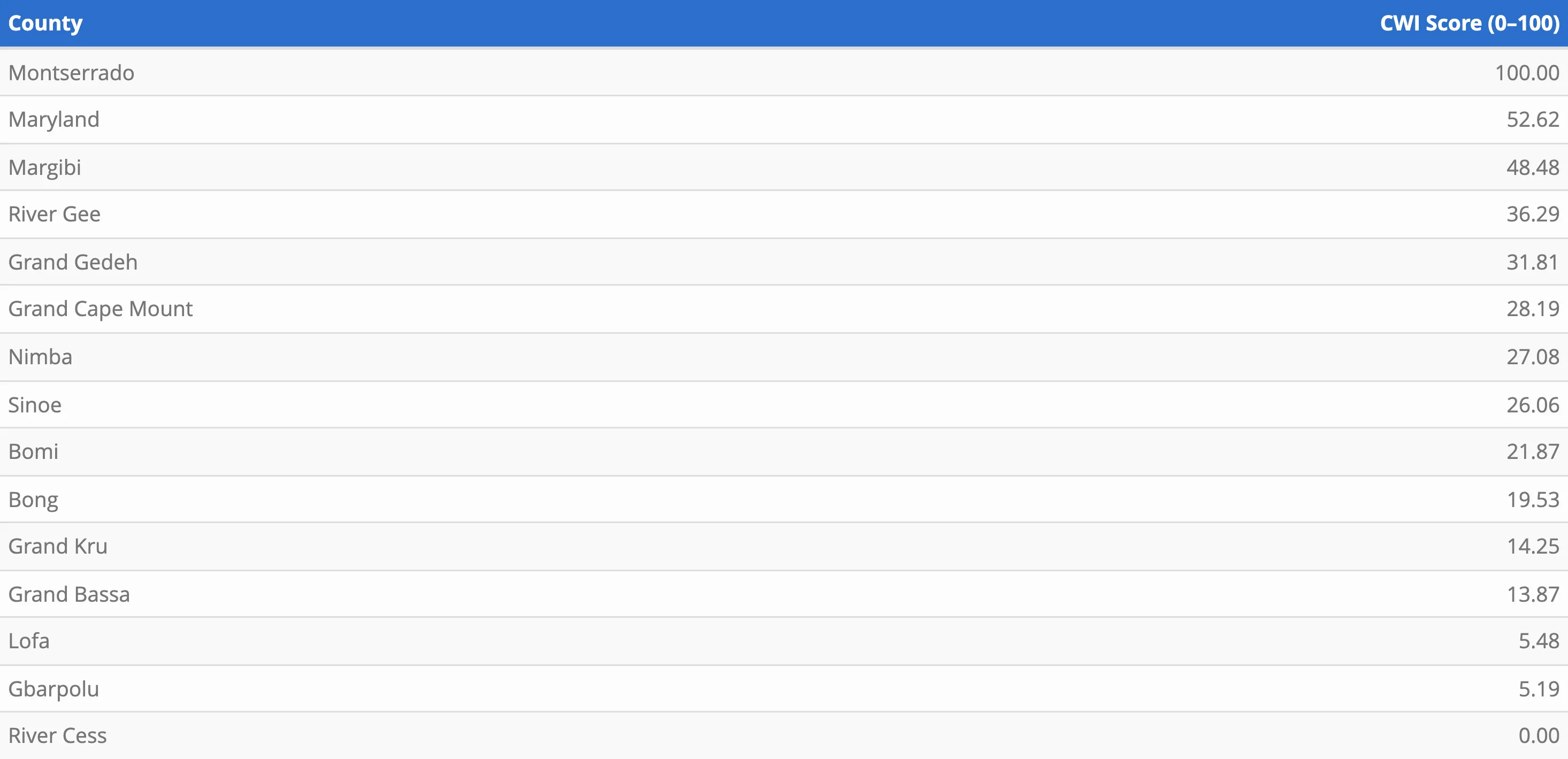
Mid-range counties such as River Gee (36.29), Grand Gedeh (31.81), Grand Cape Mount (28.19), and Nimba (27.08) fall within a moderate wellbeing band. Their scores suggest that while there is notable access to social, health, and economic opportunities, it remains uneven. These counties perform adequately to avoid extreme vulnerability but still experience gaps in service distribution and resource availability. In stark contrast, the lower half of the CWI distribution reveals several counties with significantly reduced well-being, which indicates persistent structural challenges. Counties like Sinoe (26.06), Bomi (21.87), and Bong (19.53) exhibit weaker performances, marked by limited access to essential services and decreased economic stability. Poor health outcomes, weaker governance, and higher dependence on traditional livelihoods are likely contributing factors to these low scores.
Further down the spectrum, Grand Kru (14.25), Grand Bassa (13.87), and Lofa (5.48) score extremely low, reflecting substantial developmental deficiencies. The two counties with the lowest scores, Gbarpolu (5.19) and Rivercess (0.00), showcase alarming levels of deprivation. Their scores indicate serious and multidimensional deficits in well-being, including inadequate access to vital services such as health, education, transportation, and markets. These findings highlight a stark urban-rural divide, demonstrating that many rural counties remain systematically disadvantaged compared to more urbanized or economically active areas.
When translating these CWI scores into vulnerability categories, the stratification becomes even clearer. Counties are grouped into four vulnerability levels: Least Vulnerable, Low Vulnerability, High Vulnerability, and Most Vulnerable. The Least Vulnerable group includes Montserrado, Maryland, and Margibi, which benefit from better well-being conditions relative to the rest of the country. Their stronger social and economic indicators reveal a degree of resilience.
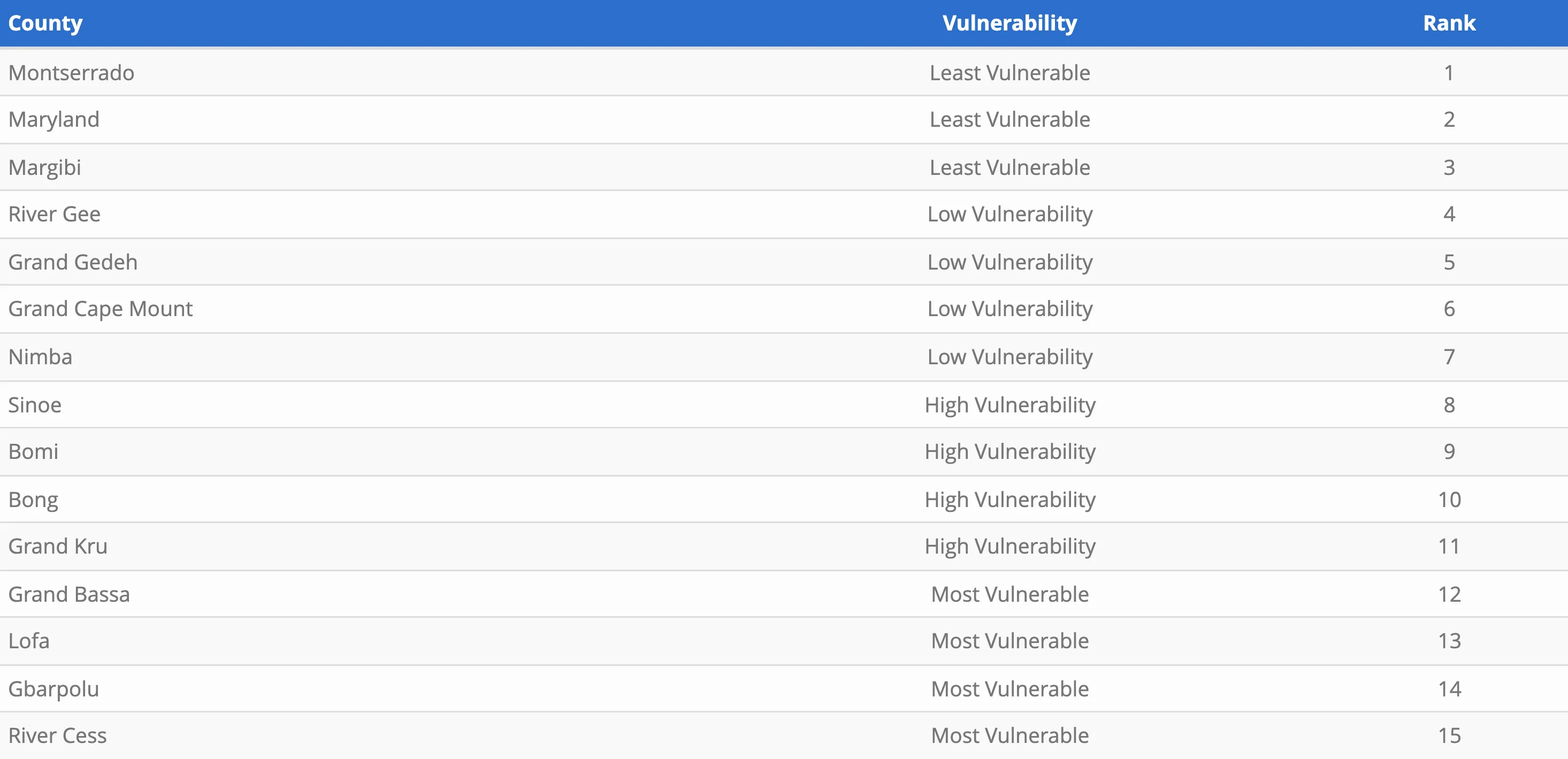
The Low Vulnerability group comprises River Gee, Grand Gedeh, Grand Cape Mount, and Nimba, which perform moderately. They are not severely deprived, but still confront noticeable challenges in achieving balanced development. The High Vulnerability group, consisting of Sinoe, Bomi, Bong, and Grand Kru, exhibits distinct structural barriers to wellbeing, characterized by weaker infrastructure, limited service availability, and greater exposure to social and economic shocks.
Finally, the Most Vulnerable counties, including Grand Bassa, Lofa, Gbarpolu, and Rivercess, represent the areas of greatest concern. Their extremely low scores indicate widespread and multifaceted deprivation, making them a top priority for targeted interventions and long-term investment.
The county rankings further emphasize this pattern of inequality. Montserrado firmly holds the top position, followed by Maryland and Margibi, showcasing a concentration of well-being in these select counties. Mid-ranked counties, such as River Gee (rank 4) and Grand Gedeh (rank 5), outperform several more populous or historically significant counties, demonstrating that population size does not always correlate with well-being outcomes. As the rankings progress downward, counties such as Sinoe, Bomi, and Bong occupy the middle to lower tiers, each exhibiting vulnerabilities that affect their overall well-being.
At the bottom of the rankings, Grand Kru (rank 11), Grand Bassa (rank 12), Lofa (rank 13), Gbarpolu (rank 14), and Rivercess (rank 15) exhibit similar patterns of deprivation, characterized by inadequate social infrastructure, limited economic opportunities, and weaker institutional capacity. Their rankings confirm that the country’s lowest levels of wellbeing are clustered among a group of rural, underserved counties, underscoring the need for equitable and regionally sensitive policymaking.
Analysis of the Regional-Level Community Wellbeing Index (CWI)
The regional-level CWI analysis consolidates county-level disparities into broader spatial patterns. Four regions, South Central, Southeastern, Northwestern, and North Central, exhibit distinct well-being profiles that closely align with the characteristics of their constituent counties.
South Central, which includes Montserrado and its surrounding counties, emerges as the most advantaged region, boasting an average CWI score of 40.59. This strong performance is primarily driven by Montserrado’s exceptionally high score, as well as the region’s comparatively better access to infrastructure, economic activity, government institutions, and social services.
In contrast, the Southeastern region, with an average score of 32.21, holds a moderate position. While it does not reach the well-being levels observed in South Central, it shows better conditions than the more vulnerable northern regions. The counties in the Southeastern region present mixed outcomes, with some demonstrating moderate performance while others face significant structural hardships. Nevertheless, the region as a whole exhibits relative stability compared to the interior regions.
The Northwestern region, with an average CWI score of 18.42, exhibits significant well-being deficits. This region includes counties such as Bomi and Gbarpolu, which rank among the lowest in the nation. The overall average for this region reflects a combination of vulnerabilities, such as limited infrastructure, inadequate service delivery, and reduced access to economic and social opportunities. Of particular concern is the Northcentral region, which records the lowest average score of 17.36, making it the most vulnerable region. This outcome is driven by the very low performances of counties like Lofa, Bong, and Grand Bassa, which collectively hinder the region’s well-being profile. These results indicate that the northern part of Liberia faces severe and systemic challenges across geographic, economic, and institutional dimensions.
The regional vulnerability categories align closely with the CWI scores. South Central is classified as the Least Vulnerable Region, enjoying the strongest well-being outcomes nationally. The Southeastern region falls under the Low Vulnerability category, indicating moderate well-being and partial access to services. On the other hand, the Northwestern region is categorized as having High Vulnerability, consistent with multiple counties exhibiting low CWI scores. Finally, North Central, with the lowest regional average, is designated as the Most Vulnerable Region, confirming its urgent need for targeted policy interventions, investment in services, and long-term development support.
This ranking highlights the profound spatial inequalities across Liberia, demonstrating that well-being is not evenly distributed throughout the country. Instead, well-being is strongly influenced by historical patterns of development, infrastructure distribution, economic concentration, and rural-urban dynamics. Despite their geographical size and agricultural significance, the northern regions face complex structural challenges that inhibit improvements in wellbeing.