Does Aid Foster Growth? Empirical Evidence from the Mano River Union Region
Haven Yarl
Abstract
This study examines the influence of foreign aid on economic growth in the four Mano River Union (MRU) countries: Liberia, Sierra Leone, Guinea, and Côte d’Ivoire, spanning the years from 2010 to 2022. Using panel data sourced from the World Bank’s World Development Indicators (WDIs), the research aims to determine whether net official development assistance (ODA) contributes to sustained economic growth or primarily serves as a countercyclical measure to stabilize fragile economies.
The analysis utilizes pooled ordinary least squares (OLS), fixed effects (FE), and random effects (RE) models to evaluate both cross-country and within-country dynamics. Descriptive findings indicate that aid inflows surged during crises, such as the Ebola epidemic (2014-2016) and the COVID-19 pandemic (2020-2021), providing necessary fiscal relief; however, there is limited evidence of a long-term impact on growth.
The FE estimation accounts for approximately 59 per cent of the variation in GDP growth, suggesting that domestic structural and institutional factors play a significant role in determining economic performance. Côte d’Ivoire and Guinea exhibit the strongest growth patterns, supported by effective policy reforms and export diversification. In contrast, Liberia’s moderate progress highlights the importance of targeted post-conflict support.
Overall, the results indicate that aid in the MRU region primarily serves a stabilizing function rather than inducing growth. To enhance the effectiveness of aid and foster sustainable and inclusive economic transformation, it is essential to strengthen fiscal management, institutional capacity, and regional integration.
Background
The MRU was established in 1973 through a treaty between Liberia and Sierra Leone. It later expanded to include Guinea in 1980 and Côte d’Ivoire in 2008. The primary purpose of the Union is to promote peace, security, and economic cooperation among its member states (Mano River Union Secretariat, 2023). Despite differing post-independence paths, these countries share several structural characteristics, such as fragile economies, a young and rapidly growing population, and a high dependence on agriculture and natural resource exports.
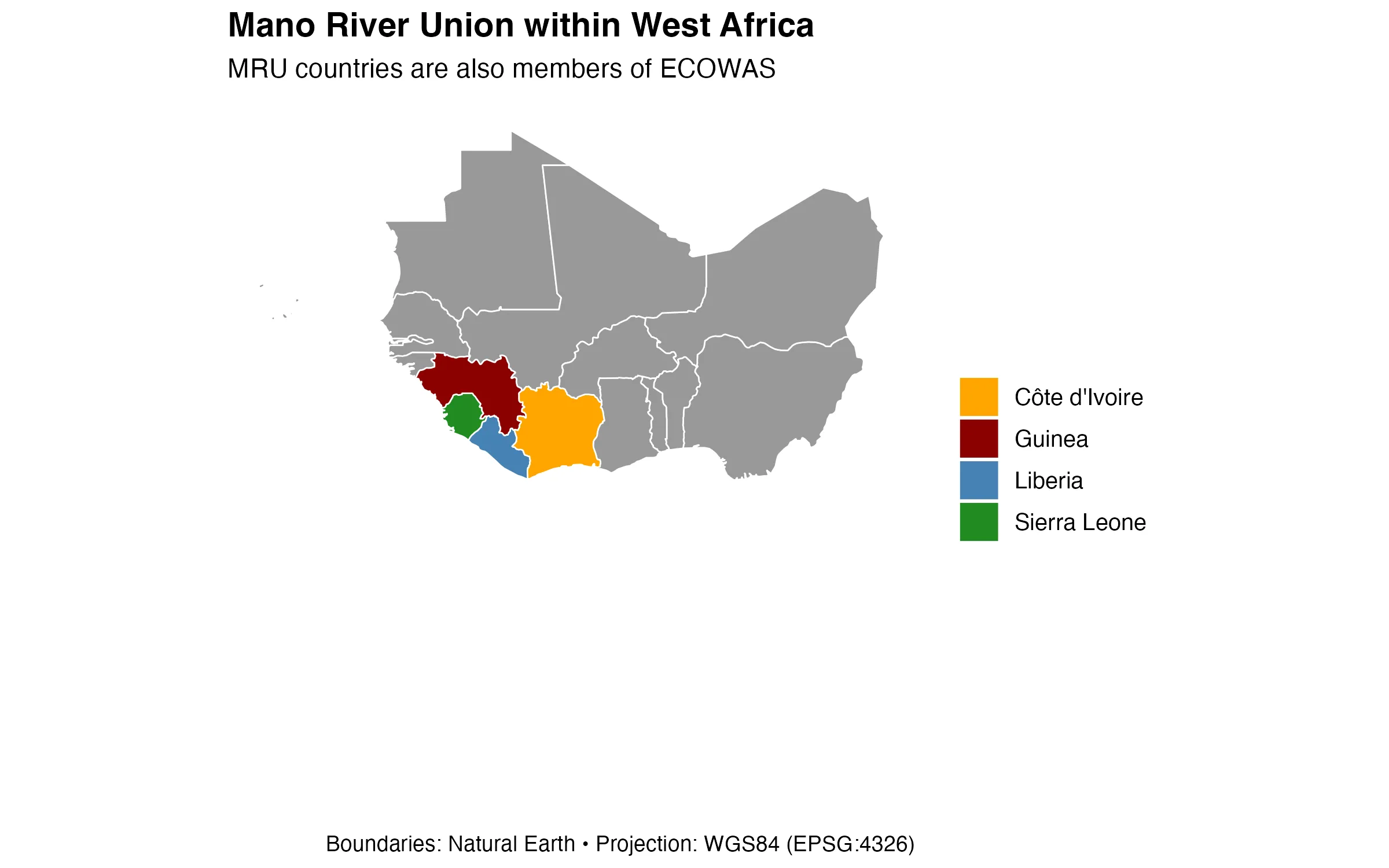
The MRU countries have faced recurrent shocks that have hindered sustained economic growth and poverty reduction. Prolonged civil conflicts in Liberia, Sierra Leone, and Côte d’Ivoire, along with political instability in Guinea, have eroded the state’s capacity and weakened its infrastructure. These challenges were further compounded by the Ebola virus epidemic from 2014 to 2016, which originated in Guinea and spread to Liberia and Sierra Leone, resulting in thousands of deaths and significant economic losses. According to the World Bank (2016), the outbreak caused GDP growth in the most affected countries to decline by over 50 percent during the crisis years. More recently, the COVID-19 pandemic has strained health systems and fiscal stability, highlighting the region’s vulnerability to external shocks.
Economically, all four MRU nations heavily rely on primary commodities, notably iron ore, cocoa, rubber, and gold, making them susceptible to fluctuations in global prices. The informal sector accounts for the majority of employment, while formal job creation and industrial diversification are limited. Consequently, poverty rates in the region remain among the highest in Sub-Saharan Africa. In 2022, the World Bank estimated that national poverty headcounts exceeded 40 percent in Liberia, Sierra Leone, and Guinea. These structural constraints emphasize the importance of sustained investment and external financing to achieve the MRU’s development goals of inclusive growth, regional trade, and social resilience (World Bank, 2022, African Development Bank/AfDB, 2023).
Development Assistance in the Mano River Countries
Development assistance has been a vital component of national reconstruction and economic stabilization in the MRU region, particularly given the challenges it faces. After years of conflict and limited domestic revenue, external aid has funded essential infrastructure, governance reforms, and social programs. In particular, ODA, defined by the Organization for Economic Co-operation and Development (OECD) as concessional financial flows from donor governments to developing countries, continues to play a significant role in public financing within the MRU (OECD, 2023).
Between 2010 and 2022, MRU countries received substantial net ODA disbursements that addressed both humanitarian and development needs. For example, donor inflows increased during the Ebola crisis, as international partners, including the World Bank, USAID, the African Development Bank (AfDB), and the European Union, financed emergency responses and recovery programs following the epidemic (World Bank, 2017). Similarly, Côte d’Ivoire received considerable aid support after its 2010–2011 post-electoral crisis, which helped rebuild infrastructure and restore macroeconomic stability (IMF, 2021).
Therefore, there is an urgent need to empirically investigate the relationship between Net ODA and GDP growth (annual per cent) across the four MRU countries during the period from 2010 to 2022. Understanding whether and to what extent aid inflows contribute to economic expansion will provide valuable insights into the effectiveness and sustainability of aid-dependent growth models in post-conflict and low-income contexts.
Assessing the Impact of Aid on GDP: Significance of the Study
Assessing the impact of development assistance on GDP growth in the MRU countries is important for several reasons. First, understanding the magnitude and direction of aid’s effects on economic performance provides valuable insights for optimizing donor engagement and national planning. Given the region’s high dependence on aid, it is crucial to determine whether ODA contributes to real growth or merely offsets budget deficits, ensuring sustainable fiscal management.
Second, this study generates comparative insights across four countries that share similar economic and institutional characteristics but differ in their capacity to absorb aid and the quality of governance. By analyzing the period from 2010 to 2022, a decade marked by events such as the Ebola outbreak, commodity shocks, and the COVID-19 pandemic, this research captures both crisis and recovery phases, revealing how aid flows interact with cyclical growth patterns.
Finally, the findings provide valuable information for regional and international stakeholders, including the MRU Secretariat, ECOWAS, the AfDB, and bilateral donors. This will help align external assistance with domestic growth strategies. Evidence-based conclusions from this study can guide resource allocation, enhance transparency, and strengthen policy coherence within the MRU framework. In summary, this research contributes to the broader discussion on aid effectiveness in low-income, post-conflict economies, offering practical implications for achieving inclusive and resilient growth in West Africa.
Methodology
This study uses a quantitative, panel-data research design to empirically assess the relationship between Net ODA and economic growth (measured as GDP growth percentage) in the four MRU countries from 2010 to 2022. The data is primarily sourced from the WDIs database, which ensures cross-country comparability and temporal consistency.
The panel structure allows for the analysis of both cross-sectional and temporal variations, capturing country-specific differences and yearly fluctuations. The econometric analysis begins with OLS as the baseline method, followed by FE and RE estimations. The FE model controls for unobserved, time-invariant country characteristics, such as geography, culture, and long-term institutional capacity, which could influence both aid and growth by isolating the impact of aid inflows on growth, accounting for structural differences between countries (Wooldridge, 2010). In contrast, the RE model assumes that these unobserved factors are random and uncorrelated with the explanatory variables.
Overall, these models provide a thorough examination of how external assistance interacts with domestic economic dynamics over time and across countries, offering policy-relevant insights into the effectiveness and sustainability of aid-driven growth within the MRU region.
Descriptive Analysis of Aid Flows (2010-2022)
Between 2010 to 2022, MRU countries experienced significant inflows of development assistance and varying economic performance (World Bank, 2023). These nations share similar post-conflict histories and face common development challenges, including fragile institutions, high poverty rates, and a reliance on external aid to support public investments and social programs (African Development Bank/AfDB, 2023). During this period, the MRU region received a substantial amount of Net ODA to rebuild infrastructure, enhance governance, and respond to recurring crises. Notably, there were sharp surges in aid during major shocks, particularly the Ebola epidemic (2014-2016) and the COVID-19 pandemic (2020-2021), highlighting the countercyclical role of foreign aid in stabilizing fragile economies. Furthermore, the period was characterized by fluctuating economic growth, alternating between periods of expansion, contraction, and partial recovery as the region navigated post-war reconstruction, health emergencies, and global market disruptions.
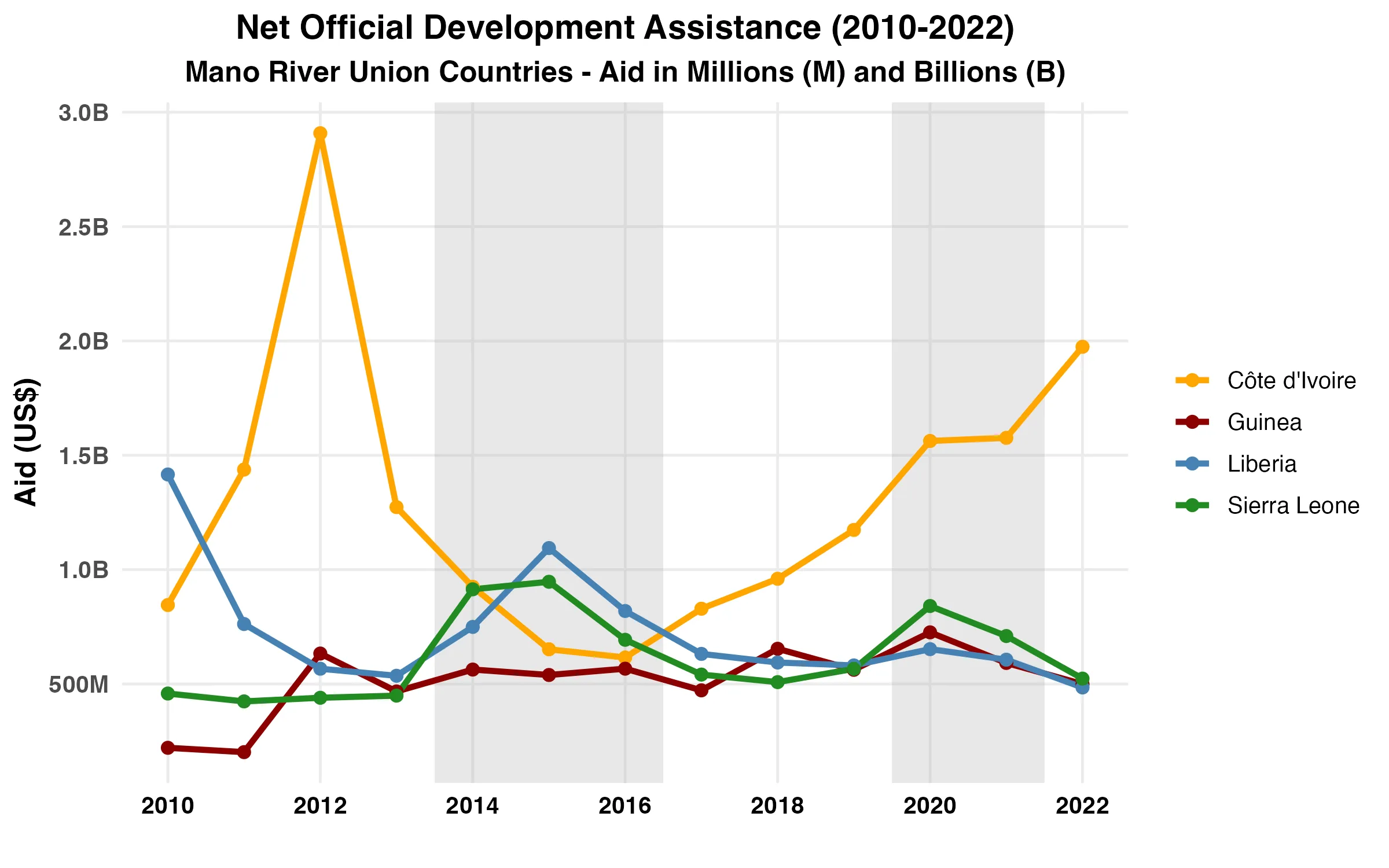
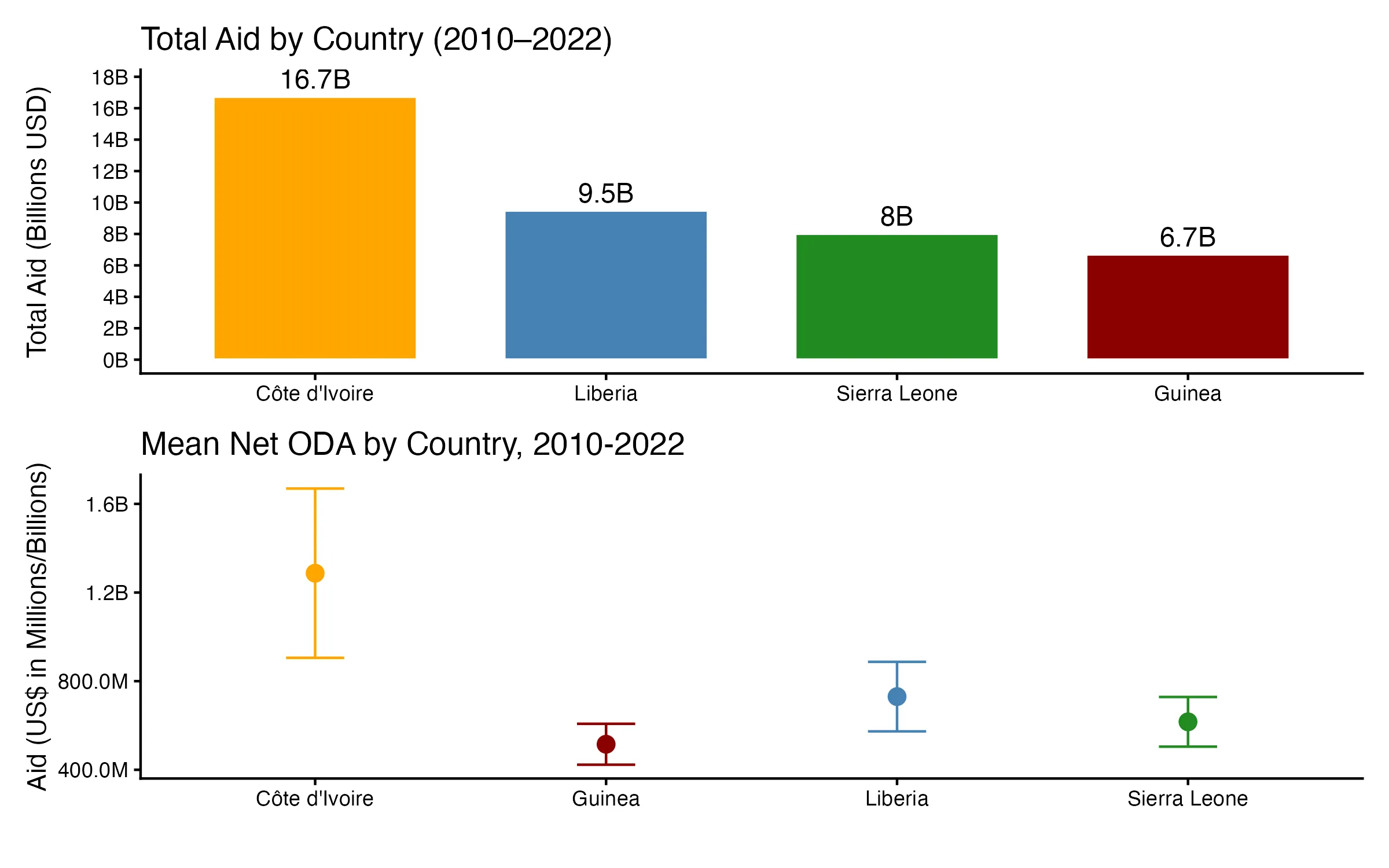
Aid disbursements across the twelve-year span were unevenly distributed, with Côte d’Ivoire receiving the largest cumulative share. Between 2010 and 2022, Côte d’Ivoire attracted approximately $16.7 billion, which constituted a significant portion of total MRU aid. This influx reflected the country’s successful post-conflict recovery, macroeconomic reforms, and strong institutional capacity to manage external funds. Liberia, emerging from a prolonged civil conflict, received about $9.5 billion in aid, primarily for reconstruction and health-related support, especially during the Ebola outbreak. Sierra Leone followed with an estimated $8 billion, which was used for extensive post-war and post-Ebola recovery financing, while Guinea received approximately $6.7 billion, the smallest total among the four countries. Average annual aid inflows were highest in Côte d’Ivoire (about $1.2 to $1.3 billion per year) and lowest in Guinea (around $0.5 billion per year). Visual analyses indicated clear spikes in aid during crisis periods, notably in 2012-2013 for Côte d’Ivoire’s post-electoral reconstruction, from 2014 to 2016 for Ebola emergency funding across Liberia, Sierra Leone, and Guinea, and again in 2020-2021 for COVID-19 pandemic relief. These patterns illustrate that aid to the MRU region is not steady or predictable; rather, it is heavily responsive to crises, with major donors reallocating funds based on humanitarian and health priorities.
Economic performance during the same period displayed similar volatility, underscoring the region’s vulnerability to both internal and external shocks. All four MRU economies underwent three distinct phases, as indicated by their GDP growth trends. The first phase (2010-2013) was characterized by robust post-war and post-crisis expansion. The second phase (2014-2016) coincided with the Ebola epidemic, which had a severe impact on economic activity across the region. The third phase (2017-2022) featured an uneven recovery, which was again interrupted by the COVID-19 pandemic. Côte d’Ivoire maintained the strongest and most consistent growth trajectory, averaging 7-8 per cent annually, thanks to its diversified export base and political stabilization after 2011. Liberia exhibited significant fluctuations, demonstrating strong early growth followed by a sharp contraction from 2014-2015, as the Ebola outbreak disrupted production and trade. However, while Liberia’s economic growth gradually recovered after 2017, it was again negatively affected during the COVID-19 period. Sierra Leone experienced dramatic economic fluctuations, including a remarkable 20 per cent expansion in 2013, driven by iron ore production, followed by a nearly 20 per cent decline in 2015 due to the combined effects of the Ebola outbreak and a drop in commodity prices ((World Bank, 2019). Although Guinea received less aid overall, it displayed steady and moderate growth of 4-6 per cent per year, supported by continuous investment in mining and energy projects, even during crisis years.
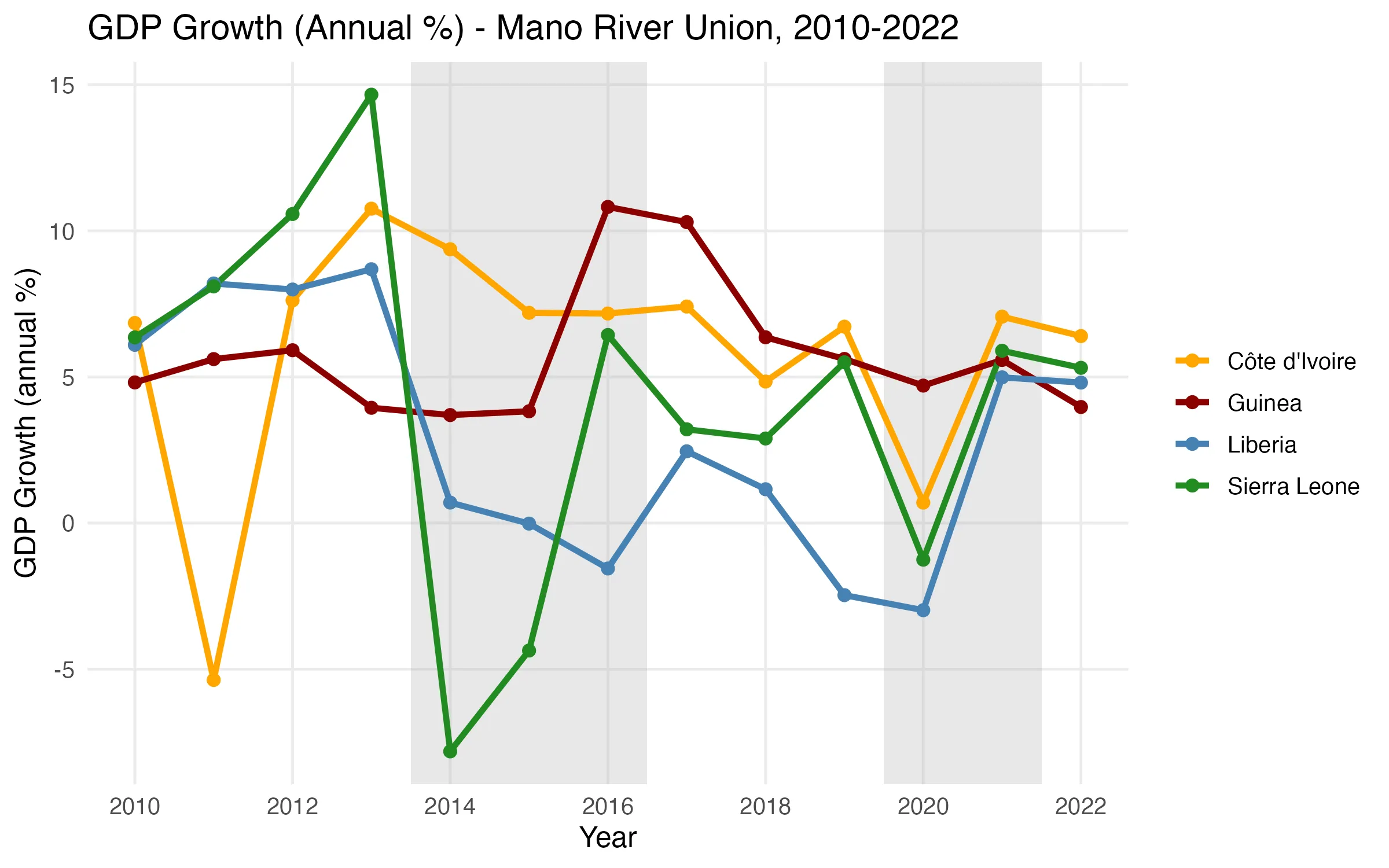
A closer examination of both aid and GDP patterns reveals important co-movements between the two variables. In years of crisis, particularly during 2014-2016 and 2020-2021, foreign aid inflows surged as GDP growth sharply declined, suggesting that development assistance played a stabilizing and compensatory role in offsetting economic disruptions. The timing of these spikes and troughs indicates aid’s countercyclical nature: when economic output contracted, donor disbursements increased to provide fiscal relief and sustain social spending (African Development Bank/AfDB, 2023). However, while aid effectively mitigated short-term economic collapses, its influence on long-term growth trajectories appears inconsistent. Côte d’Ivoire’s sustained growth, even amid fluctuations in aid, indicates that internal policy and structural reforms are as crucial as donor inflows. Conversely, Liberia and Sierra Leone show signs that high aid volumes during crises were followed by slow and incomplete recoveries, highlighting their limited capacity to absorb aid and structural dependence on external resources. Guinea’s more modest but stable growth suggests resilience despite receiving less aid, emphasizing the importance of internal investment and governance strategies.
Fixed Effects Analysis: Impact of Aid on Economic Growth (2010-2022)
$Y_{it} = \beta_1\cdot X_{it} + \alpha_i + e$
$GDP_{it} = \beta_1\cdot Aid_{it} + a_i\cdot country + e$
The fixed effects estimation investigates the relationship between net ODA and GDP growth within the four MRU countries from 2010 to 2022. This model controls for unobserved heterogeneity that could skew cross-sectional analyses, such as differences in governance quality, infrastructure, or geography, by allowing each country to have its own intercept or baseline. By doing so, the model focuses on how year-to-year changes in aid inflows within a country correspond to changes in its economic growth, holding constant all country-specific, time-invariant factors. This approach provides a clearer understanding of whether fluctuations in aid are associated with measurable short-term growth effects in fragile, aid-dependent economies.
The analysis results indicate that the connection between aid and economic growth is weak. In every version of the model, the estimated effect of aid on growth is slightly negative but too small to be considered statistically significant. This means that between 2010 and 2022, changes in the amount of aid received by a country did not lead to clear increases or decreases in its annual economic growth. In simpler terms, while aid levels fluctuated over time, often in response to crises such as the Ebola outbreak or the COVID-19 pandemic, these shifts did not directly result in faster or slower growth. This finding aligns with previous research, which shows that in fragile or post-conflict countries, foreign aid often serves a more stabilizing or humanitarian role rather than acting as a direct engine of economic expansion (Burnside & Dollar, 2000; Easterly, 2003; Clemens et al., 2012)
A closer examination of individual countries reveals significant differences in their overall growth performance. Côte d’Ivoire exhibited the strongest results, with an average annual growth rate of approximately 8.9 per cent over the study period. This reflects the country’s successful recovery from conflict, steady economic reforms, and diversified export industries that supported rapid growth. Guinea also performed well, with an average growth rate of around 7.0 per cent, driven by its expanding mining and energy sectors, which helped maintain moderate progress even during global or regional crises. Sierra Leone experienced a similar trend, with an estimated growth advantage of approximately 5.7 per cent, indicating continued post-Ebola reconstruction and investment in public infrastructure. Liberia, while still showing positive growth, displayed a smaller growth advantage of approximately 4.7 per cent, reflecting moderate economic progress but continued vulnerability to aid dependence and external shocks.
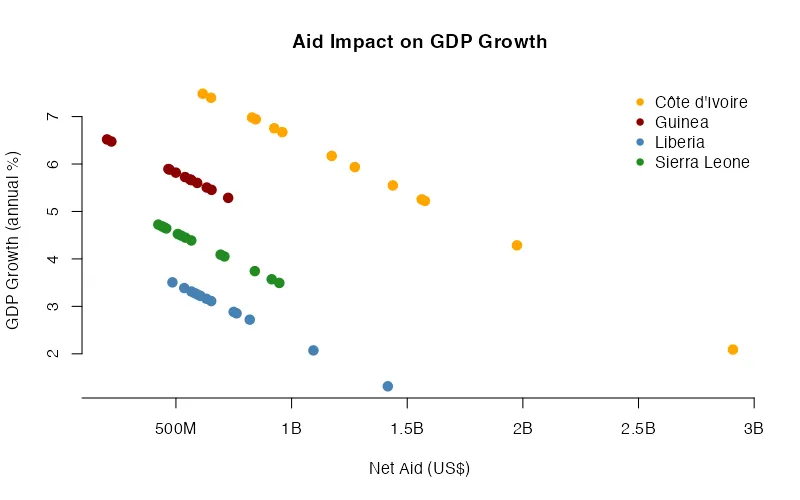
The fitted-value plot of predicted GDP growth against net aid visually confirms these relationships. The distribution of points shows that changes in aid (measured in millions and billions of US dollars) do not correlate with proportional changes in GDP growth. Côte d’Ivoire’s data points cluster toward higher aid and higher predicted growth, while those for Liberia and Sierra Leone are positioned lower, reflecting weaker economic performance despite similar aid inflows. Guinea’s points are more centered, consistent with its moderate but steady growth pattern. The overall flat slope of the fitted relationship suggests that, once unobserved country-specific effects are controlled for, aid inflows have a negligible marginal effect on growth.
Overall, the estimation suggests that net ODA in the MRU region between 2010 and 2022 played a countercyclical and stabilizing role rather than directly driving economic growth. Aid inflows typically increase during crisis periods, such as the Ebola epidemic (2014-2016) and the COVID-19 pandemic (2020-2021), helping to cushion economic downturns without significantly accelerating recovery. Côte d’Ivoire’s consistently high growth, despite fluctuating aid, highlights the importance of domestic reforms, macroeconomic stability, and export diversification in sustaining long-term performance. Similarly, Liberia’s positive growth trajectory reflects moderate progress despite its dependence on aid and structural fragility, suggesting that targeted assistance and improved fiscal coordination have contributed to gradual post-conflict recovery and resilience.
Discussion and Recommendations
This study demonstrates that foreign aid has played a crucial role in stabilizing the economies of the MRU, but it has not consistently led to sustained economic growth. This means that while development assistance remains crucial for macroeconomic stability and crisis mitigation, its ability to generate sustained growth depends on the presence of strong institutions, efficient public investment mechanisms, and economic diversification. From 2010 to 2022, ODA primarily served as a countercyclical tool, increasing sharply during crises such as the Ebola epidemic and the COVID-19 pandemic. This assistance aimed to cushion economic shocks and maintain public spending. However, the econometric analysis showed that the link between aid inflows and GDP growth is weak and statistically insignificant. This suggests that while aid may alleviate short-term downturns, it does not necessarily promote long-term development.
Country-level results reveal significant contrasts within the MRU region. Côte d’Ivoire’s robust and sustained growth is attributed to structural reforms, macroeconomic discipline, and export diversification. Guinea’s positive trajectory highlights the benefits of resource-based investments and gradual enhancements in institutional strength. In contrast, Liberia and Sierra Leone illustrate the limitations of aid-driven recovery without deeper structural changes. The findings confirm that the effectiveness of aid heavily depends on each country’s governance quality, absorptive capacity, and policy coherence.
To improve aid effectiveness and foster resilience, MRU governments and development partners should aim to strengthen fiscal transparency, enhance investment efficiency, and align aid programs with national development priorities. Regional coordination through the MRU Secretariat, ECOWAS, and the AfDB can further facilitate shared learning, harmonized policies, and sustainable growth strategies. By prioritizing institutional capacity-building, diversification, and results-based planning, the MRU countries can transform external assistance into a catalyst for inclusive and lasting economic progress.